
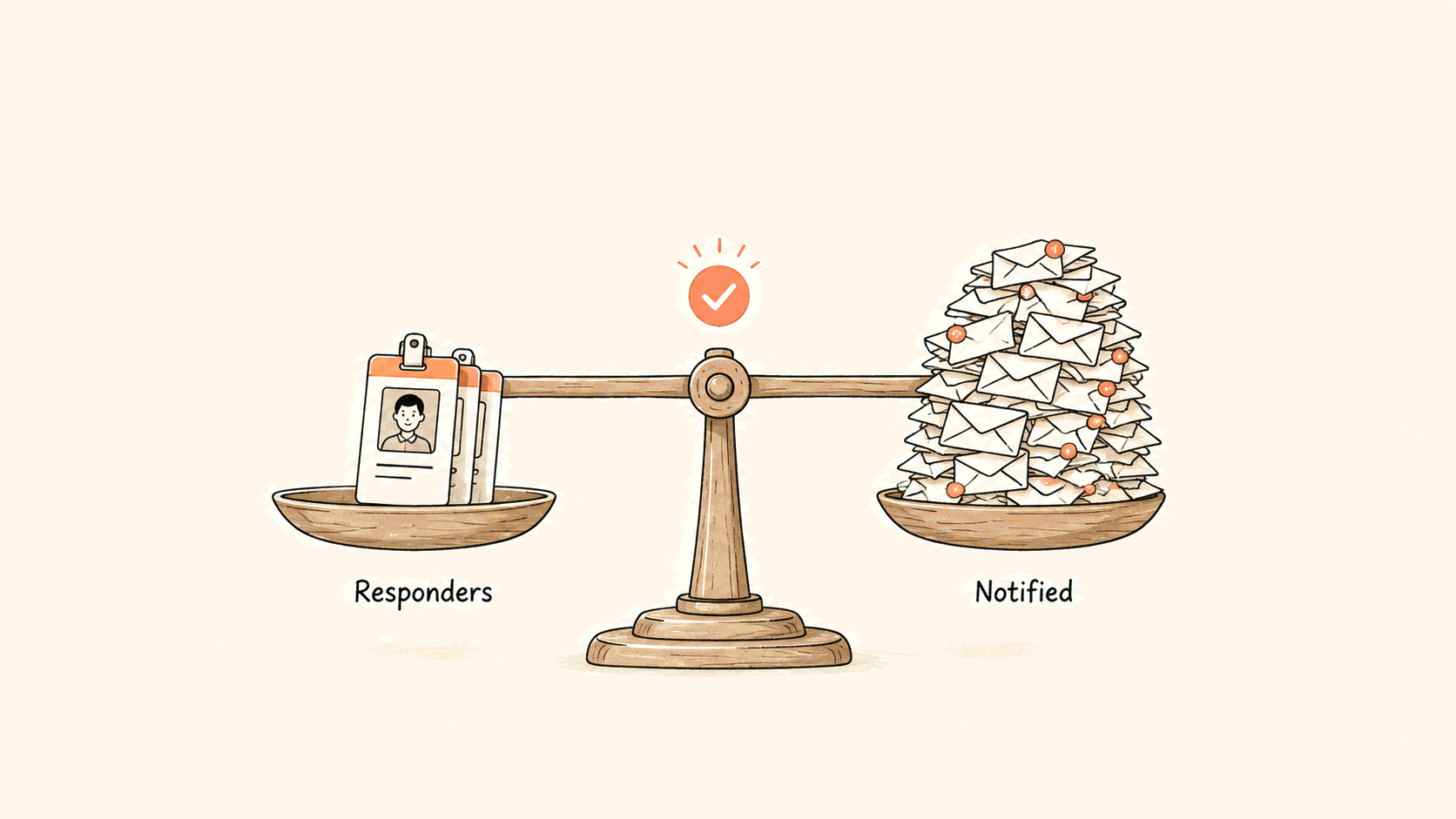
If 15 of your 100 engineers handle incidents, the biggest line in your on-call budget is how the other 85 are billed. On PagerDuty Business, 100 full seats cost $4,100 a month. With 85 read-only Stakeholder licenses instead, the estimate drops to about $915 a month. Flashduty Professional licenses only the 15 responders, at $435 a month.
This post compares six alternatives on that question, plus AI, status pages, and migration. It also says when PagerDuty is still the better choice. Prices are list prices as of October 2026. Check each vendor's page before you budget.
Four questions separate the tools
Feature checklists look the same after the fifth vendor. These four questions don't:
- Who needs a paid seat? Can notification-only people get paged without a full seat? This is usually the largest cost lever.
- Where does the response happen? In a web console, in Slack or Microsoft Teams, or in the chat tool your responders already use, such as Feishu, DingTalk, or WeCom?
- What does the AI do? Does it summarize, or does it run diagnostics in your environment? Ask for a live demo on a problem the vendor hasn't seen.
- What does migration cost? Can your existing alert integrations switch without rewriting payloads?
What PagerDuty charges for
PagerDuty's Incident Management pricing lists Professional at $21 per user per month and Business at $41, billed annually ($25 and $49 billed monthly). The pricing FAQ says that every person added to the account is a paid user, including people who only receive notifications or appear in a schedule.
PagerDuty also sells Stakeholder licenses for people who don't respond. Stakeholders get read-only access, and on Business they can subscribe to incident updates. They start at $150 per month for a pack of 50. Stakeholders can't be paged, so anyone on a schedule still needs a full seat.
Other costs are add-ons. AIOps starts at $699 per month and PagerDuty Advance (generative AI) at $415 per month, annual commitment only. Professional includes one external status page with up to 250 subscribers. Larger or private status pages cost extra.
PagerDuty's AI is broader than a summarizer. Its SRE Agent, Paige, analyzes logs and runbooks, recalls similar incidents, and runs approved remediation. Scribe, Shift, and Insights agents cover call notes, schedule conflicts, and analytics. Most of these require PagerDuty AI, which is an add-on below the top plans.
The six alternatives
1. Flashduty: responder-only licenses and China-native chat
Full disclosure: this is our product. Read this section as a vendor's self-assessment, then verify it in a trial.
Flashduty covers alert intake, noise reduction, schedules, escalation, war rooms, postmortems, and status pages. It differs from PagerDuty in three ways:
- Only responders need a license. Members who only receive notifications by phone, SMS, email, or chat don't need one. Status-page subscribers are free and don't need an account. For the 100-person team above, that's 15 licenses.
- Response happens in your chat tool. Flashduty has native apps for Feishu, DingTalk, and WeCom, including their on-premises editions, plus Slack, Teams, Zoom, and Telegram. One click opens a war-room group chat with a live incident card. The iOS app uses Apple Critical Alerts to break through Do Not Disturb.
- AI SRE runs diagnostics. AI SRE runs in a cloud sandbox or on your own runner and executes diagnostic commands in your environment. You can extend it with skills, MCP tools, subagents, and the Agent2Agent (A2A) protocol.
Scheduling includes primary and backup roles, multi-person rotations, fair rotation, and dynamic assignment from CMDB data. Flashduty accepts the PagerDuty Events API format, so you can point existing integrations at it without rewriting payloads.
Pricing: Professional lists at $29 per user per month on the pricing page. It includes intelligent alert grouping, AI summaries, AI postmortem drafts, and AI SRE. AI SRE usage is metered in credits. Standard and Professional don't cap users, schedules, or daily alert volume. Phone, SMS, and email beyond the included quota are billed per use.
Trade-offs: PagerDuty has 750+ integrations; Flashduty lists 60+. PagerDuty supports calendar export; Flashduty doesn't. Flashduty is less known to multinational procurement teams. If your company is US- or EU-only and standardized on Slack, PagerDuty or incident.io will feel more familiar.
Best for: Teams of 50 to 5,000 that want everyone notified without paying for everyone, and that coordinate in Feishu, DingTalk, or WeCom.
2. incident.io: Slack and Teams native response
incident.io runs the incident inside Slack or Microsoft Teams. Alerts declare incidents, channels open automatically, the timeline records itself, and AI drafts the postmortem.
Pricing: On the pricing page, Team is $15 per user per month billed annually ($19 monthly), plus $10 for on-call. Pro is $25 plus $20 for on-call. With on-call, that's $25 to $45 per user per month on annual billing. On-call is also sold alone at $20 per user per month.
Trade-offs: There's no native support for China chat tools. Deep noise-reduction controls and private deployment aren't its focus.
Best for: Software as a service (SaaS) teams of 50 to 500 on Slack or Teams that care more about response coordination than alerting depth.
3. Grafana Cloud IRM: for Grafana-centric stacks
Grafana archived OnCall open source on March 24, 2026. Development continues in Grafana Cloud IRM (incident response and management), which keeps alerts, dashboards, and on-call in one place.
Pricing: On the Grafana pricing page, the free tier includes three active IRM users. Pro starts at $20 per active IRM user per month, plus a $19 monthly platform fee.
Trade-offs: Status pages aren't native, and its response features are younger than its observability features. Many teams keep Grafana as the alert source and route alerts to a dedicated response platform.
Best for: Teams already on Grafana Cloud that want on-call without another vendor.
4. Better Stack: monitoring and on-call in one product
Better Stack combines uptime monitoring, logs, status pages, and on-call. The free tier works for small teams, and setup takes an afternoon.
Pricing: On the pricing page, a responder license is $29 per month billed annually ($34 monthly). Team members who don't respond are free.
Trade-offs: Complex multi-team escalation, deep noise reduction, and enterprise compliance needs outgrow it quickly.
Best for: Startups and small infrastructure teams that want monitoring and basic on-call in one tool.
5. FireHydrant: service catalogs and structured response
FireHydrant focuses on service ownership, runbooks, and structured retrospectives.
Pricing: On the pricing page, Pro is $25 per responder per month billed annually, with a 10-responder free tier. Its on-call product, Signals, is billed by alert volume. Viewer licenses, private status pages, and FireHydrant AI are Enterprise features.
Trade-offs: It's web-first, and it has no native support for China chat tools.
Best for: Larger organizations with mature service catalogs.
6. Jira Service Management: if you already run on Jira
Atlassian moved Opsgenie's alerting and on-call into Jira Service Management (JSM). If your incidents, changes, and tickets already live in Jira, JSM keeps them together. Native status pages are Enterprise-only; other plans use the separate Statuspage product.
Best for: Organizations standardized on Jira and Confluence.
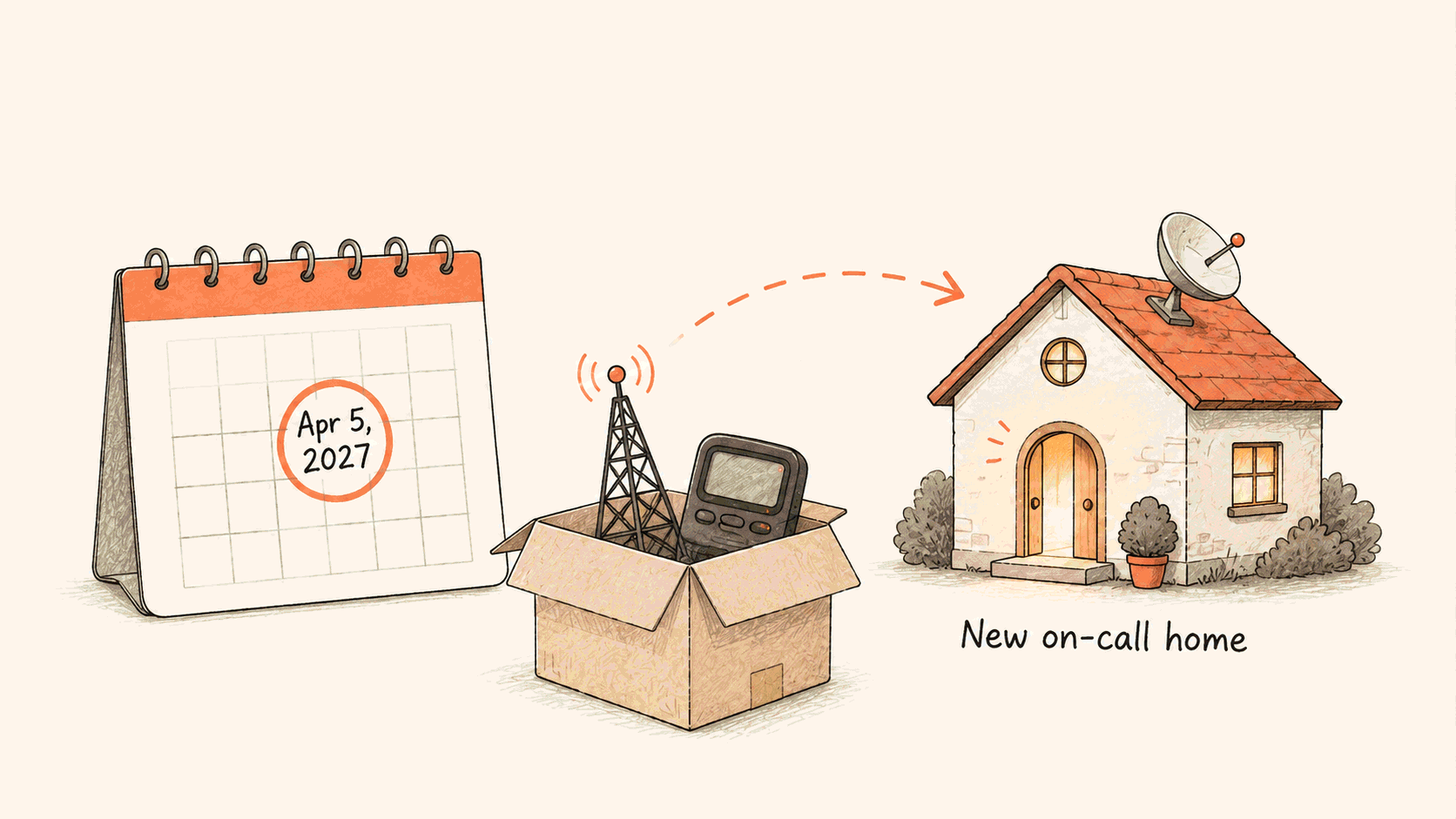
Opsgenie itself isn't on this list. Atlassian ended new sales on June 4, 2025, and support ends on April 5, 2027. See our Opsgenie migration guide.
Comparison table
| Platform | Pricing (list, October 2026) | Notification-only users | Status pages |
|---|---|---|---|
| Flashduty | $29/user/mo Professional | Free | Public included; internal on Professional |
| PagerDuty | $21–41/user/mo + add-ons | Full seat, or read-only Stakeholder from $150/50 users/mo (not pageable) | One external page on Professional; more are add-ons |
| incident.io | $25–45/user/mo with on-call (annual) | Per-user pricing | One public page on all plans |
| Grafana Cloud IRM | $20/active user/mo + $19 platform fee | Active users are billed | Not native |
| Better Stack | $29/responder/mo (annual) | Free team members | Included |
| FireHydrant | $25/responder/mo (annual) + Signals by alert volume | Viewer licenses on Enterprise | Public pages included |
The cost for a 100-person team
Assume 15 people acknowledge, escalate, and close incidents. The other 85 only need updates when their systems are involved. All figures are in US dollars at list price.
| Option | Monthly | Annual |
|---|---|---|
| PagerDuty Business, 100 full seats | $4,100 | $49,200 |
| PagerDuty Business, 15 full seats + 85 Stakeholders (assumption below) | about $915 | about $10,980 |
| Flashduty Professional, 15 licenses | $435 | $5,220 |
The Stakeholder row assumes two 50-user packs at $150 each. PagerDuty sells packs of 50, 250, 500, 1,000, and 5,000 and doesn't publish prices above the first tier. The two PagerDuty rows also cover different things. Stakeholders can follow incidents but can't be paged. On Flashduty, all 100 people can receive phone and SMS alerts.
So Flashduty costs about 89% less than the all-seat case and about 52% less than the Stakeholder case. Neither figure includes PagerDuty add-ons or Flashduty communication overage. The full model is in our on-call cost breakdown.
Migrate in stages
- Connect alerts first. Flashduty accepts the PagerDuty Events API format, so most integrations only need a new endpoint. Run both platforms in parallel.
- Rebuild schedules and escalation policies on purpose. Delete the rotation rules nobody can explain.
- Shadow for one to two weeks. Page both systems and compare delivery latency on voice, SMS, and every chat tool you use.
- Cut over team by team. Keep the PagerDuty contract until the last team's escalation path has fired for real.
For a feature-by-feature breakdown, see Flashduty vs PagerDuty in our docs.
When PagerDuty is still the right choice
Stay on PagerDuty if you need its integration catalog, if procurement requires the incumbent, or if most of your notification-only people can work as read-only Stakeholders. If many people need to be paged without being responders, or your team works in China chat tools, test an alternative with a real workload. Connect one alert source, run your worst escalation path, and page yourself at 3:00 AM.
Start a Flashduty trial · Compare plans
Sources, checked October 2026: PagerDuty Incident Management pricing, PagerDuty AIOps pricing, PagerDuty AI agents, incident.io pricing, Grafana pricing, Grafana OnCall OSS archival notice, Better Stack pricing, FireHydrant pricing, Atlassian Opsgenie licensing FAQ, and Flashduty pricing.