
Every major model vendor now ships its own general-purpose AI agent: Codex, Claude Code, Cursor, Kimi, and so on. They write code, write articles, do design work, and troubleshoot problems. They are already remarkably capable. So why would anyone need an SRE Agent?
SRE stands for Site Reliability Engineering. Broadly, everything about keeping software stable after it ships falls under SRE.
It's a pointed question.
We built AI SRE (an SRE Agent) into Flashduty. If it turns out nobody actually needs an SRE Agent, our business case falls apart. And not just ours. Has your company rolled out its own SRE Agent, probably built by the ops team? Sorry, that one falls apart too.
Can general-purpose AI agents handle SRE work?
Honestly, they can handle a lot of it. Especially once a problem has been narrowed down to a specific module: an engineer points Cursor or Claude Code at the local code plus production logs and metrics, and most common issues get solved.
When the problem doesn't get solved, there are two things to look at:
- The model isn't smart enough, so you need a better model.
- The model didn't get enough information, so you need more precise context.
In fact, if you watch closely, you'll notice that people on the same team using the same model get wildly different results. Some can't describe the problem clearly. Some forget to give the model a key piece of data. Some have poorly written local Skills or incomplete knowledge bases. They have the agent, but they aren't getting much out of it.
This exposes the real issue: knowledge sharing. And sharing goes hand in hand with collaboration. Personal-assistant agents like Codex and Cursor naturally lack some of the capabilities a team needs to work together. What usually happens is that information passes from person to person, and then each person passes it on to their own Codex. Information gets lost along that chain, and the whole thing moves only as fast as the people in it.
Speaking of knowledge sharing and collaboration, I have to mention Claude Tag.
What is Claude Tag?
Besides Claude Code, Anthropic has another product that many people may have missed: Claude Tag. The overview below was summarized by Claude Code :)
Claude Tag is a Slack product Anthropic launched on 2026-06-23, replacing the earlier Claude in Slack app. It's positioned as an AI teammate that lives in Slack, which is exactly what it sounds like.
Key features:
- Always on, with memory: it keeps context and memory over the long term. Given permission to read other channels, it can also draw on information from elsewhere in the organization.
- Does the work itself: when it gets a task, it breaks it into stages, uses whatever tools it has access to, and posts the results back to the Slack thread.
- Ambient mode: it can join conversations on its own, share progress updates, flag things worth noticing elsewhere, and follow up on forgotten threads or tasks.
- One shared Claude identity for the whole company: colleagues can hand off half-finished tasks to each other. Usage in channels is billed to the organization, not to individuals.
- Privacy: Anthropic says it won't leak content from private channels.
- Anthropic calls it the beginning of Claude Code's evolution and says it will expand to other platforms, though no timeline has been given.
What Claude Tag tells us
Anthropic treats Claude Code and Claude Tag as two separate products. That tells you Anthropic believes Claude Tag has its own distinct positioning and value.
As for an SRE Agent, I see it as roughly: Claude Tag + Incident Responder.
- Claude Tag: focused on knowledge sharing and collaboration, especially collaboration inside IM tools.
- Incident Responder: focused on incident response. It needs to integrate all kinds of data access, incident analysis, and postmortems, and for more advanced users, Status Page as well.
What an SRE Agent does
Here are the typical responsibilities and traits of an SRE Agent. By the end, you'll probably have a feel for the difference.
Runs 24/7
Your local Codex or Cursor stops working when your laptop is off. An SRE Agent runs 24/7.
Picks up incidents automatically and runs the first round of diagnosis
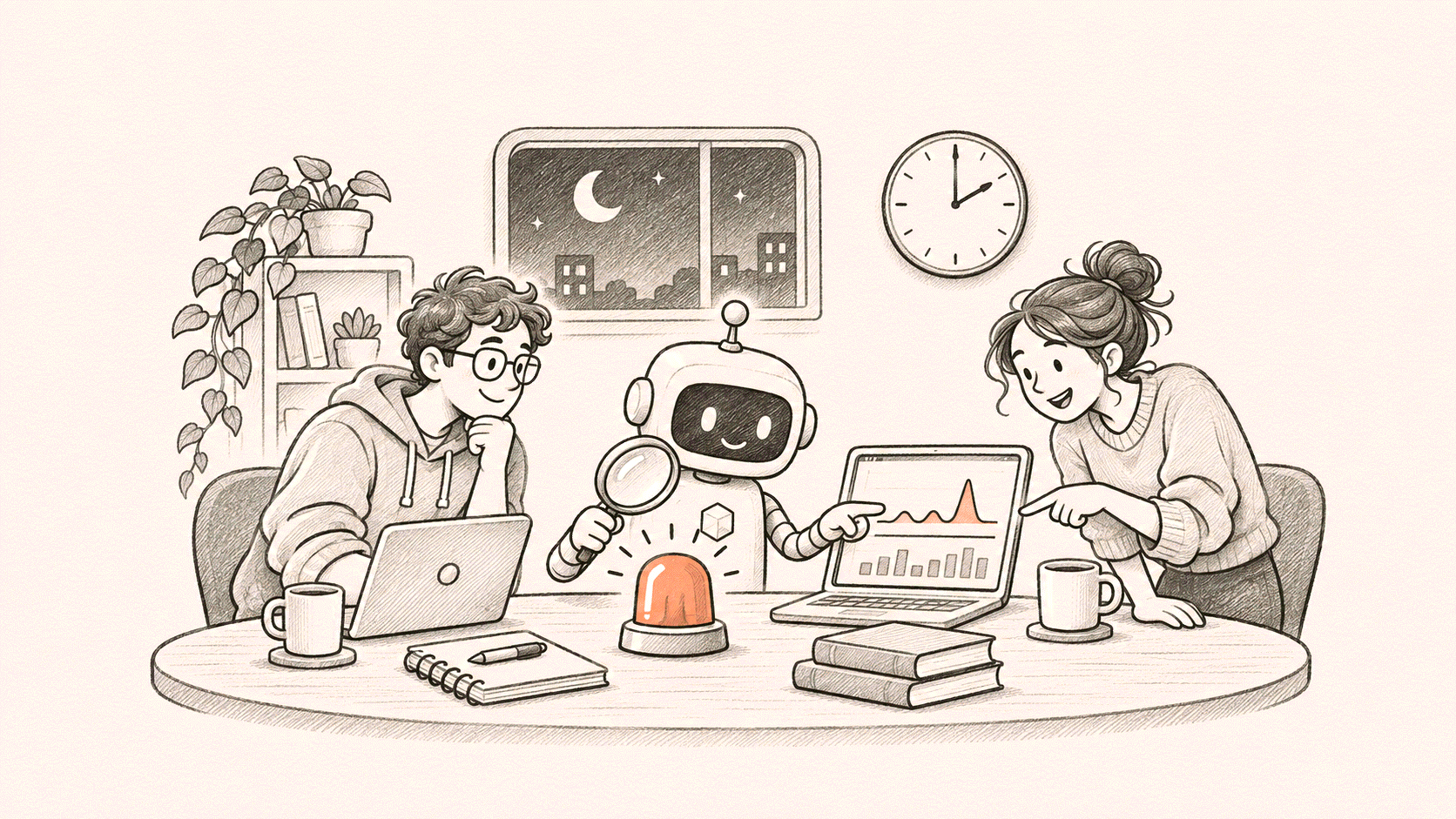
When an incident wakes you up at 3 a.m., you want to open your eyes to the AI's initial analysis already waiting for you, not start feeding it context and then sit around waiting for an answer.
But alerts are scattered across platforms: Prometheus, Zabbix, various cloud monitoring services, and the monitoring built into all sorts of commercial software. Should the SRE Agent integrate with each of them one by one? Frankly, that's a lot of work.
Then there are alert storms. Analyzing every single alert doesn't make sense. You need to reduce the noise first, usually by grouping related alerts into a single incident, and then run AI RCA on a manageable number of incidents.
As it happens, pulling alerts from every monitoring system into one place and deduplicating and grouping them is exactly what on-call products like Flashduty and PagerDuty do. That's why building the SRE Agent into Flashduty fits so naturally.
Connects to all kinds of data
General-purpose agents can of course connect to data too, since many data sources offer MCP servers. But plenty of data sources don't, and even when they do, the MCP server isn't always pleasant to use. An SRE Agent needs data source integration to work out of the box.
A few examples:
- We provide a self-hosted Runner that reaches into private networks, so the AI running in our SaaS can read data from specific data sources inside a given network zone.
- We provide a component called monitedge that connects to all kinds of observability data sources and exposes built-in, structured Tools. These Tools handle security guardrails as well as data analysis and processing. For instance, feeding raw metric data to the AI would blow up its context window, so monitedge offers a metric trend analysis tool and hands the AI the results instead. Raw logs can be huge, so monitedge offers a log pattern tool and gives the AI the pattern analysis.
- For code hosts like GitHub and GitLab, we provide a GitHub App for centralized, authorized access. Even if the agent can't read the code directory on your laptop, it can still read the code through the GitHub App and pinpoint the issue faster.
- For Kubernetes, we provide a dedicated Kubernetes App that makes network access easy and keeps permissions tight, so the AI can read K8s data.
- For giant MCP servers like Alibaba Cloud's, we don't dump every tool definition onto the AI. Instead we wrap them in a Search tool, so the model's context doesn't overflow.
- And so on.
There's a long road from an SRE Agent demo to something production-grade.
Helps with incident collaboration and response
An SRE Agent has to live in your IM tools, with dedicated apps for Feishu (Lark), WeCom, DingTalk, Slack, Teams, and others, because an ordinary IM bot can't do collaborative operations. When an incident comes in, it needs to create a war room (a dedicated IM group) and sync the incident timeline there so everyone can work together.
Once the incident is resolved, the SRE Agent should read the war room conversation along with the investigation records across the incident's lifecycle, and draft the postmortem. That frees up a lot of human effort.
If your company has a public status page, like DeepSeek's status.deepseek.com, then during a major outage you need to communicate transparently with the public by updating the status page as the response progresses. That's also the SRE Agent's job.
Wrapping up
So an SRE Agent really is quite different from a personal-assistant-style general-purpose agent. Of course, since we build Flashduty AI SRE, we're not exactly neutral here, so please judge for yourself. If you're interested in Flashduty On-call and our SRE Agent, take a look and give it a try: Flashduty