

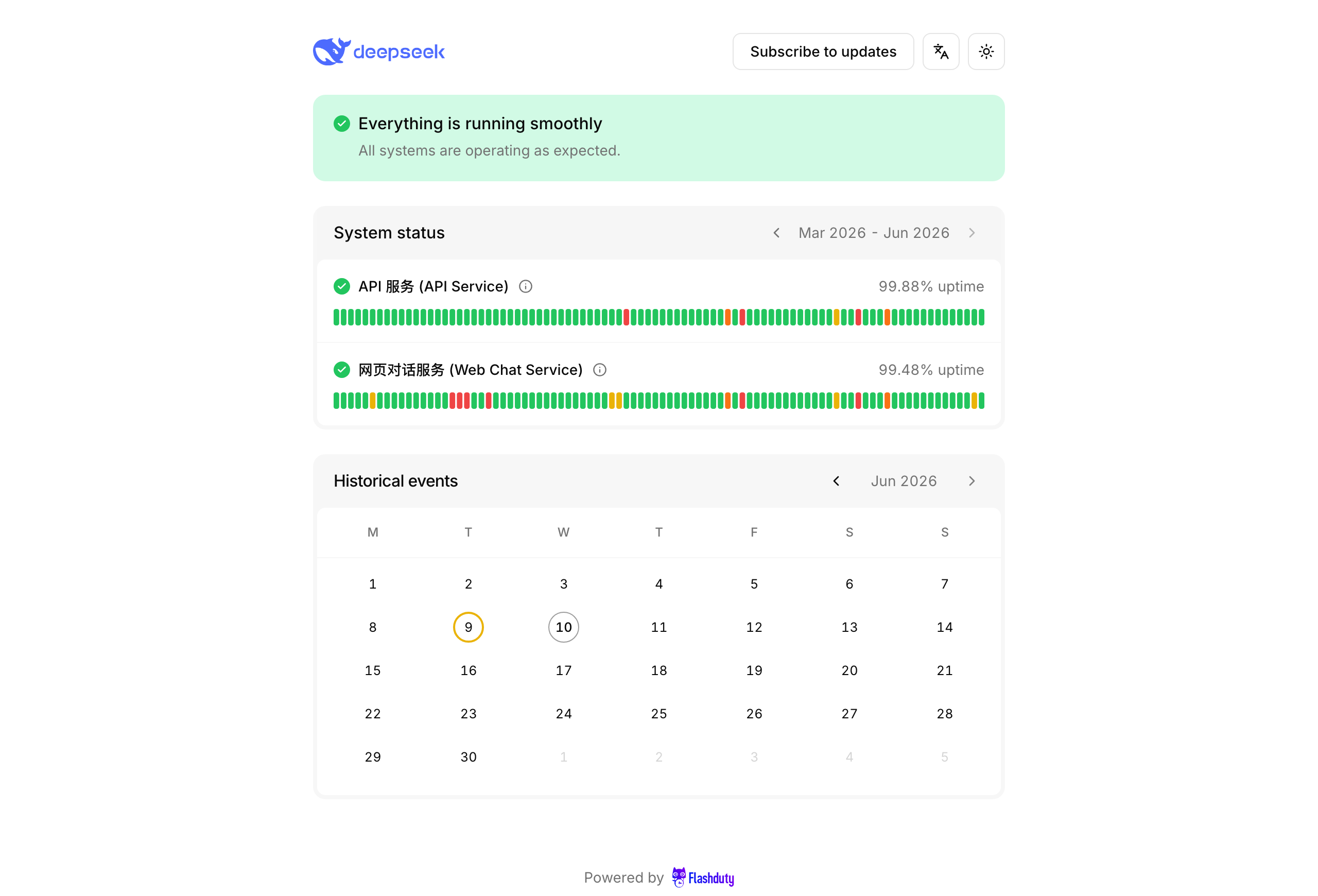
Checking whether DeepSeek is up right now? The official status page is status.deepseek.com, served by Flashduty Statuspage. The rest of this post covers the migration.
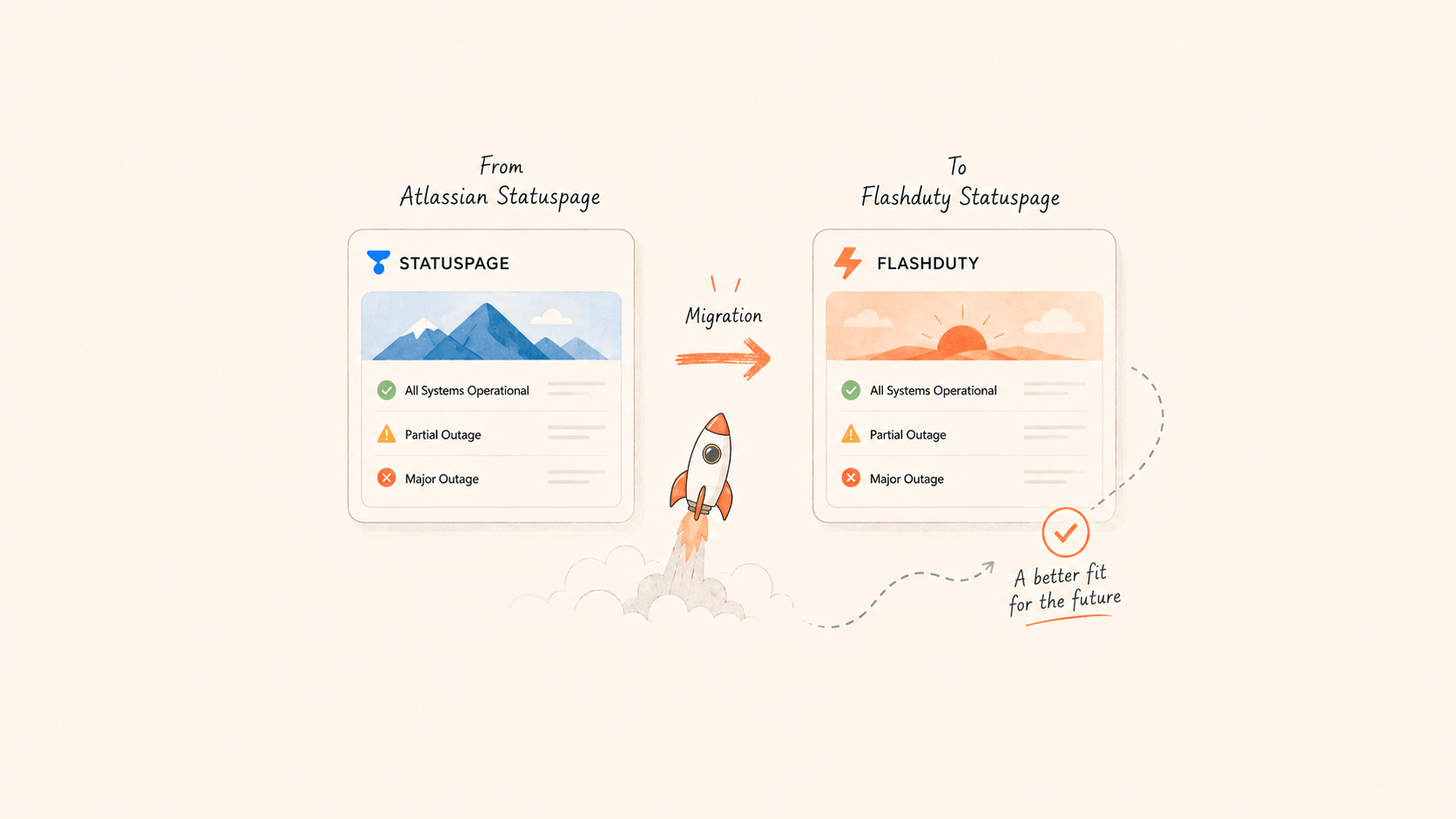
DeepSeek has moved its public status page from Atlassian Statuspage to Flashduty Statuspage. Three factors drove the choice: native Chinese, cost, and page experience. The migration ran in two steps with two CLI commands, and subscribers didn't have to verify their email again.
Few people visit a status page on a normal day. When a service has problems, it becomes one of the few places outsiders can look. Users refresh it, customers forward it, and the media watch it. A status page carries your external communication during an incident, so don't pick one as if it were a display page.
Three reasons to choose Flashduty
Chinese support
As far as we know, Atlassian Statuspage's public pages don't have native Chinese today. Multi-language support relies on a third-party localization tool such as Localize. Most of DeepSeek's users read Chinese, and an English-only status page during an incident makes for a poor experience.
Flashduty supports Chinese natively, with a language switch on the page. Component names can be bilingual, such as "API 服务 (API Service)". One page serves users in China and abroad.
Cost
Atlassian Statuspage is a standalone product, priced in tiers by subscribers, components, and team members. A public page plus an internal page can cost thousands of dollars a year.
Flashduty's status page is included in On-call at no extra charge. If your team already uses On-call, the status page is one more outlet on the same incident response path. The main usage-based cost left is email delivery.
Page experience
Dark mode, rendering performance, and global access acceleration are baseline expectations now. If DeepSeek's status page loaded slowly, looked blurry, or was unstable from abroad, people would notice. Flashduty's status page is designed to today's standards for public pages, not as an old ops console with a new skin.
The two products also differ in smaller ways. Examples include maintenance events that don't count against uptime, per-incident subscriptions, and component display control. Bulk subscriber import and export differ too. For these differences and the pricing math, see the status page comparison doc.
Why not build your own
Many engineers look at a status page and think they could build one. If you only need to show a few components and post incident timelines, that's not hard. The hard parts are elsewhere.
Credibility
A status page is for people outside your company. Hosting it on an independent third party is more credible than hosting it on your own servers. When you're down, outsiders don't have to wonder whether you're grading your own homework. The status page also doesn't go down with your services. Self-hosting can't give you that independence by design.
Ongoing maintenance
A status page isn't a static page. Subscription management, email delivery, availability stats, incident timelines, and internal pages all need someone to build and maintain them. For most teams, none of this is core business, so the engineering time is hard to recover.
Capabilities you can't add quickly
Email reputation is the clearest example. Reliable delivery to tens of thousands of subscribers depends on IP and domain reputation built over time, SPF/DKIM/DMARC setup, and bounce and complaint handling. Without that history, your email lands in spam.
Incident traffic is similar. A status page is quiet until something breaks, then everyone arrives at once, and the peak often exceeds your normal service load. Both capabilities depend on time and scale, and a few more lines of code won't solve them.
How the migration avoids disturbing subscribers
DeepSeek migrated rather than rebuilt. The Flashduty CLI splits the migration into two steps to reduce risk:
- Run
flashduty status-page migrate-structureto import components, groups, incident history, and notification templates. This step doesn't touch subscribers. Check the structure and history in the console before you continue. - Run
flashduty status-page migrate-email-subscribersto import subscribers. They're active right away, with no re-verification email.
Finally, point your custom domain's CNAME to Flashduty and go live once everything checks out.
RSS subscribers don't need to change anything. Flashduty is compatible with Atlassian's history.rss and history.atom formats, so the old URLs keep working. For command arguments and the full steps, see the migration section of the status page comparison doc.
Teams that can follow this path
Choosing a status page takes more than checking whether it can show service status. Consider Chinese support, cost, the credibility of self-hosting, email reputation, incident traffic, and subscriber migration.
If you're on Atlassian Statuspage and most of your users read Chinese, you can follow DeepSeek's approach.
Related docs: